
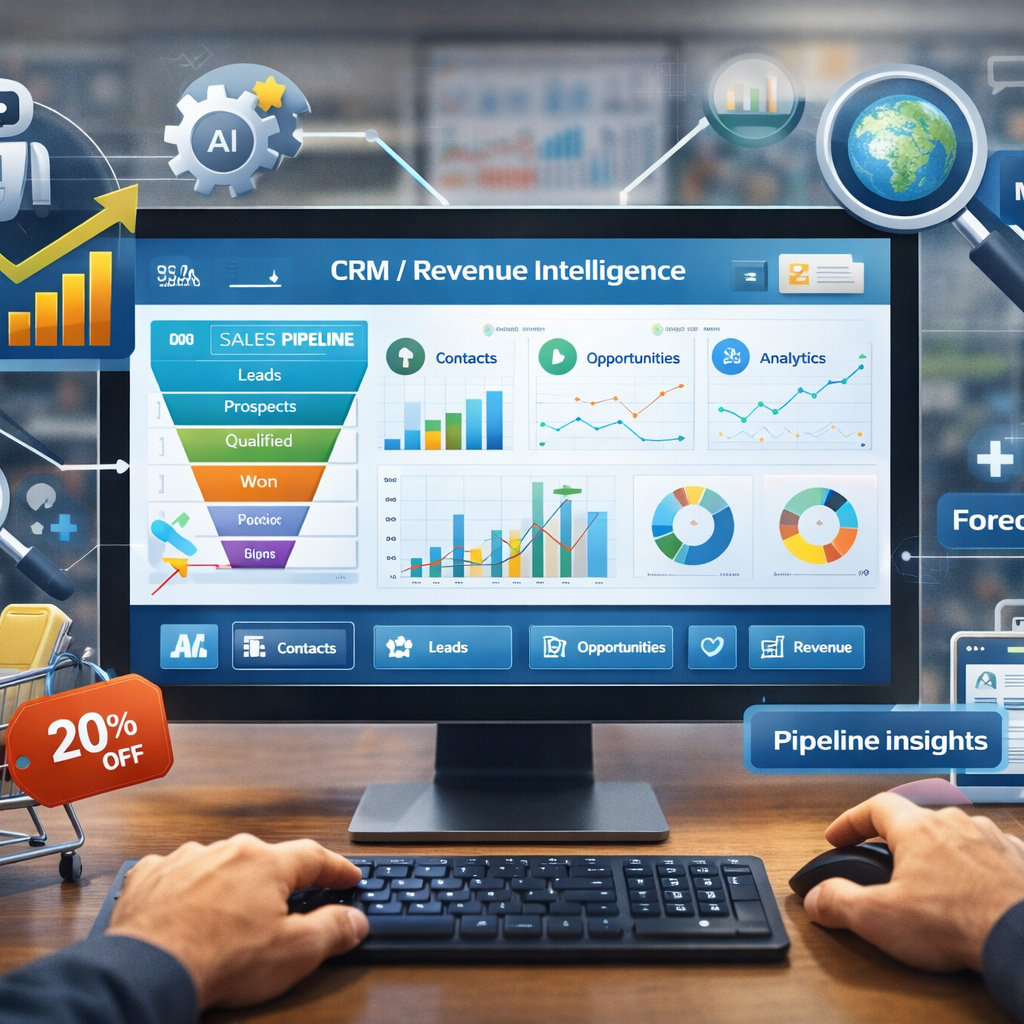
How CRM Systems Are Evolving Into Full Revenue Intelligence Platforms
Key Takeaways
-
CRM systems are shifting from data storage tools into revenue intelligence platforms that guide decisions across marketing, sales, and customer success.
-
You need to focus on unified data, predictive insights, and cross-functional visibility to unlock the full value of modern CRM systems.
Understanding The Shift Toward Revenue Intelligence Platforms
You are no longer working with traditional CRM systems that only track contacts and deals. The modern CRM system is evolving into a full revenue intelligence platform. This shift is driven by the need for deeper insights, faster decisions, and stronger alignment across teams.
A revenue intelligence platform goes beyond record keeping. It connects data, analyzes behavior, and helps you act with clarity. It gives you a clear view of your revenue pipeline, customer journey, and growth opportunities.
Why CRM Systems Are Expanding Beyond Data Management
You are dealing with more data than ever. Customer interactions now happen across multiple channels. This makes simple data storage ineffective.
Modern CRM systems are evolving because:
-
You need real-time visibility into revenue performance
-
Teams require shared insights instead of siloed data
-
Decision-making must be faster and more accurate
-
Customer expectations are higher and more dynamic
This shift transforms CRM systems into central intelligence hubs that guide your revenue strategy.
What Defines A Revenue Intelligence Platform Today
You should understand what makes a CRM system a true revenue intelligence platform. It is not just about features. It is about how the system connects and interprets data.
Key capabilities include:
-
Unified data across marketing, sales, and support
-
Predictive analytics for forecasting and planning
-
Automated insights that highlight risks and opportunities
-
Real-time reporting and dashboards
-
Behavioral tracking across the full customer lifecycle
These capabilities allow you to move from reactive decisions to proactive strategy.
How Does Data Unification Improve Revenue Visibility?
You cannot generate meaningful insights if your data is scattered. Revenue intelligence platforms solve this by unifying your data sources.
When your data is connected:
-
You see the full customer journey in one place
-
You identify patterns across channels and touchpoints
-
You reduce errors caused by duplicate or outdated records
-
You improve collaboration between teams
This level of visibility helps you make better decisions at every stage of the revenue cycle.
How Predictive Analytics Changes CRM Value
You are no longer limited to historical reports. Predictive analytics transforms your CRM system into a forward-looking tool.
With predictive capabilities, you can:
-
Forecast revenue with greater confidence
-
Identify high-value leads earlier
-
Detect deal risks before they impact outcomes
-
Optimize resource allocation across teams
Predictive insights help you act before problems arise, not after they occur.
Why Cross-Channel Insights Are Critical For Revenue Intelligence
Customer behavior is no longer linear. You must track interactions across multiple channels to understand intent.
A modern CRM system captures signals from:
-
Email engagement
-
Website activity
-
Sales interactions
-
Customer support conversations
By connecting these signals, you gain a complete view of customer behavior. This allows you to deliver more relevant experiences and improve conversion rates.
How Automation Enhances CRM System Intelligence
Manual processes slow down your ability to act. Automation is a core part of revenue intelligence platforms.
You can automate:
-
Data entry and updates
-
Lead scoring and routing
-
Alerts for key changes in pipeline activity
-
Reporting and performance tracking
Automation ensures your data stays accurate and your teams stay focused on high-value tasks.
What Role Does AI Play In CRM Evolution?
Artificial intelligence is a key driver of CRM transformation. It enables deeper analysis and smarter recommendations.
AI enhances CRM systems by:
-
Identifying patterns that are not visible to humans
-
Recommending next best actions for sales and marketing
-
Improving forecasting accuracy
-
Personalizing customer engagement at scale
You can use AI to turn raw data into actionable insights that directly impact revenue outcomes.
How CRM Systems Improve Alignment Across Revenue Teams
You often see gaps between marketing, sales, and customer success teams. These gaps reduce efficiency and slow growth.
Revenue intelligence platforms solve this by creating shared visibility.
Benefits include:
-
Consistent data across all teams n- Clear understanding of pipeline stages and metrics
-
Improved handoffs between departments
-
Better accountability and performance tracking
When teams work from the same data, alignment improves and revenue processes become more efficient.
How Does Real-Time Reporting Drive Better Decisions?
You cannot rely on outdated reports in a fast-moving environment. Real-time reporting is essential for modern CRM systems.
With real-time insights, you can:
-
Monitor pipeline health continuously
-
Adjust strategies based on current performance
-
Respond quickly to changes in customer behavior
-
Identify opportunities as they emerge
This allows you to stay proactive instead of reactive.
How Customer Lifecycle Tracking Enhances Revenue Strategy
You need to understand the full customer lifecycle, not just individual transactions. Revenue intelligence platforms track every stage.
This includes:
-
Initial awareness and engagement
-
Lead qualification and conversion
-
Customer onboarding and retention
-
Upsell and expansion opportunities
Lifecycle tracking helps you identify where value is created and where improvements are needed.
What Challenges Should You Expect In CRM Transformation?
You may face challenges when moving toward a revenue intelligence platform.
Common issues include:
-
Data quality and consistency problems
-
Resistance to change within teams
-
Integration complexity with existing tools
-
Lack of clear strategy for using insights
You should address these challenges early to ensure a smooth transition.
How Should You Approach CRM System Optimization?
You should treat CRM transformation as an ongoing process. It is not a one-time setup.
Focus on:
-
Continuous data cleaning and validation
-
Regular review of metrics and dashboards
-
Training teams to use insights effectively
-
Aligning CRM strategy with business goals
This ensures your CRM system continues to deliver value over time.
What Metrics Define Success In Revenue Intelligence Platforms?
You need to track the right metrics to measure success.
Key indicators include:
-
Pipeline velocity and conversion rates
-
Forecast accuracy
-
Customer retention and expansion
-
Sales cycle length
-
Engagement across channels
These metrics help you evaluate performance and refine your strategy.
How Will CRM Systems Continue To Evolve?
You can expect CRM systems to become even more intelligent and integrated. The focus will remain on delivering actionable insights and improving decision-making.
Future developments may include:
-
Deeper AI integration across workflows
-
More advanced predictive modeling
-
Enhanced automation capabilities
-
Greater personalization of customer experiences
You should prepare for continuous innovation and adapt your strategies accordingly.
Building A Revenue-Driven CRM Strategy For Long-Term Growth
You need to move beyond viewing CRM systems as simple tools. They are now central to your revenue strategy.
To succeed, you should:
-
Prioritize data integration across all systems
-
Invest in analytics and automation capabilities
-
Align teams around shared revenue goals
-
Focus on delivering consistent customer experiences
A strong CRM strategy supports sustainable growth and long-term success.
Final Thoughts On CRM And Revenue Intelligence Evolution
You are operating in a landscape where data drives every decision. CRM systems have evolved into platforms that provide deep insights into revenue performance and customer behavior.
You should take a proactive approach to adopting these capabilities. Focus on integration, analytics, and alignment. This will help you unlock the full potential of revenue intelligence platforms.
You are encouraged to take the next step by signing up on Credkeeper to streamline your revenue intelligence strategy and improve decision-making across your organization.